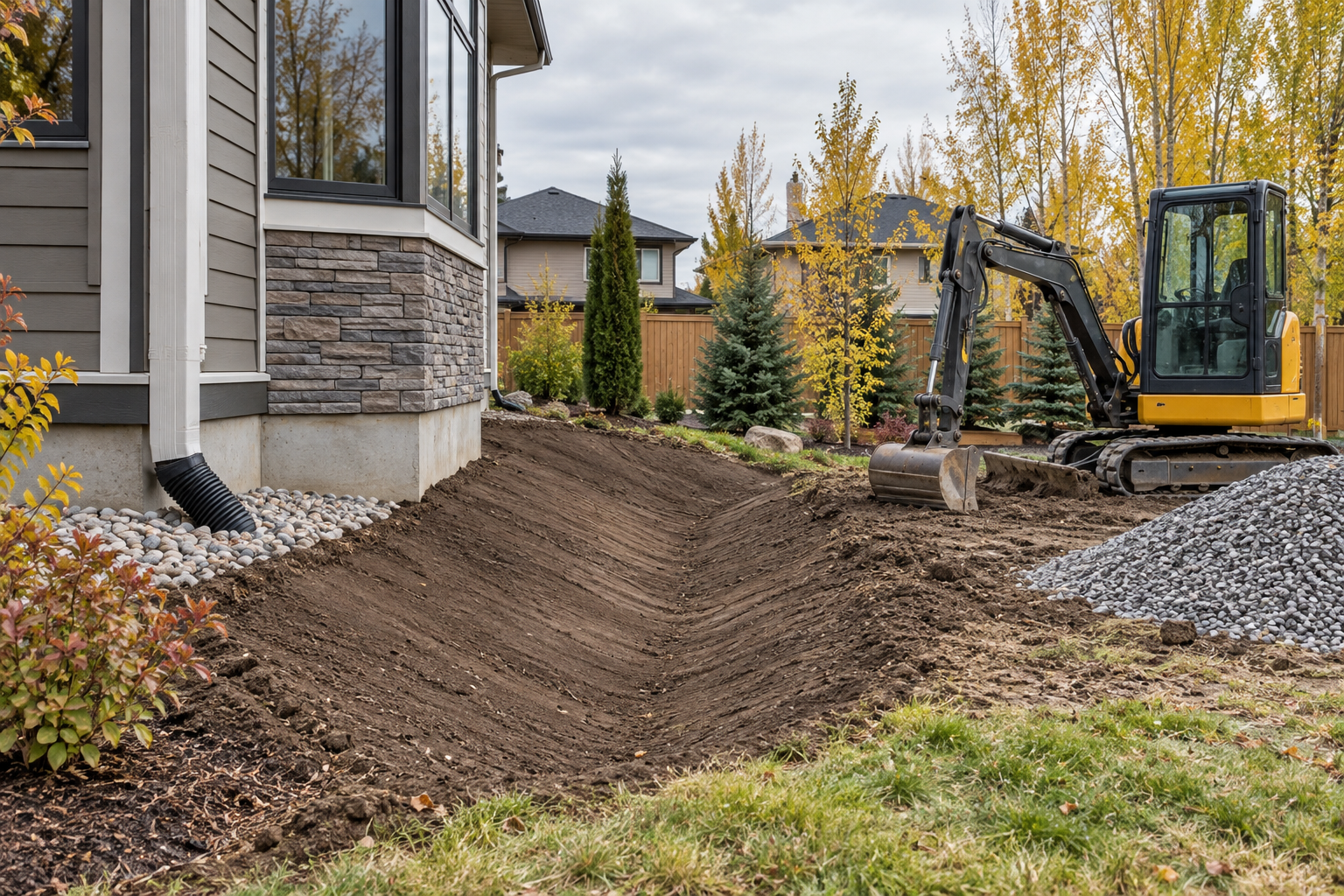
Before winter in Edmonton, the useful question is not simply whether a yard looks level. It is where rain and snowmelt collect, how water moves beside the foundation, and whether the site has a clear, safe path for that water to leave the house area. A practical inspection in fall can identify a grading, downspout, drainage or excavation question before frozen ground makes changes more difficult.
Shan Construction provides excavation and grading service in Edmonton and supports homeowners, builders and property managers with drainage-related site preparation. The company serves Edmonton plus nearby communities including Sherwood Park, St. Albert, Beaumont and Leduc. This article explains what to observe and how to describe a concern clearly; it does not replace a site-specific assessment, municipal requirement or engineered drainage plan.
Why drainage grading matters before an Edmonton winter
Water that repeatedly sits beside a foundation can create problems long after a single rainfall. In autumn, a low area may be easy to spot after rain; during winter, snow accumulates in the same low area and spring thaw can reveal the consequence. The goal is not to promise that grading alone solves every moisture issue. It is to understand the source, guide surface water away from the building where the site plan allows, and avoid burying a problem beneath landscaping or frozen ground.
Edmonton-area properties vary widely. A newer lot in Beaumont may need a final-grade correction after construction. An older home in St. Albert may have settled soil beside the foundation. A narrow infill site in Edmonton can have tight side-yard access and neighbouring grades to consider. The property’s drainage route, materials, utilities, lot lines and local requirements matter more than a generic amount of fill.
Start with a simple fall water-path inspection
Walk the property after a normal rain, if it is safe to do so, and again when the ground is dry. Look from the roofline outward: downspouts, paved areas, planting beds, lawn, swales, fence lines and the street or lane can all affect where water ends up. Take time-stamped photos from the same locations. They make a contractor conversation far more useful than a description such as “the yard floods.”
- Foundation edge: note soft, sunken or persistently wet areas beside the house.
- Downspouts: observe where they discharge and whether water immediately returns toward the foundation.
- Hard surfaces: check whether a driveway, patio or walkway directs runoff toward the building.
- Low points: photograph puddles, ice-prone spots and areas where water remains after surrounding ground has dried.
- Property edges: identify fence lines, neighbouring yards, lanes, catch basins or visible drainage features that affect the available path.
Do not dig near suspected utilities or assume a visible wet spot identifies the source. Arrange locates before excavation and keep the original observations available for the site review.
Separate surface grading from foundation drainage
Surface grading and below-grade drainage are related but are not interchangeable. Grading shapes the exterior ground and directs surface water. A weeping tile system is part of foundation drainage and may require excavation, access to the foundation area and a project-specific plan. A contractor should identify which issue is being addressed rather than treating every wet area as the same repair.
If the concern is close to the foundation or includes recurring seepage, discuss it with Shan Construction as part of a possible weeping tile installation or repair scope. If the project involves reshaping the site, imported material or removal of unsuitable soil, the excavation and grading service is the more direct starting point. The right answer may include both scopes, or it may begin with a simpler surface-water correction.
When a drainage-grading project may need more than soil
Downspout and roof-water routing
A downspout can concentrate a large amount of roof runoff in one small area. Before adding fill, establish where the water is leaving the downspout and whether its discharge route works with the property’s grade. A planned route should not create a new issue at a walkway, driveway, neighbour’s property or municipal feature. The applicable local rules and property conditions govern the final approach.
Settlement, landscaping and hardscape changes
Soil placed at construction can settle, and later landscaping can change the original path of water. Garden edging, retaining elements, mulch beds, patios and new concrete may all create a dam-like edge or redirect runoff. On a recently built garage or addition, the transition between new work and existing yard is especially worth inspecting. Shan Construction can coordinate grading as part of broader Edmonton construction contractor work when the drainage question is tied to a site change.
Access, material movement and disposal
A quote should state how material moves through the site. Some projects need unsuitable soil removed; others need clean material delivered and placed. Where hauling is required, Shan Construction’s trucking and slinger service can be relevant to delivery, removal or difficult access. Ask what the price includes for loading, trucking, disposal, imported material and cleanup so two estimates can be compared fairly.
What to include when asking for a drainage grading quote
A useful request gives the contractor enough context to assess the real site instead of guessing. Include the address, photos taken after rain, the age of the home if known, the locations of downspouts and any history of water entry or prior drainage work. Identify the desired outcome: for example, correcting a settled side yard, preparing an area before landscaping, or coordinating a foundation-drainage repair.
- Which side or sides of the building are affected?
- When does water collect: rainfall, snowmelt, irrigation or all of these?
- What site features constrain access: fence, gate, driveway, overhead line, tree, deck or neighbouring structure?
- Is the scope limited to surface grading, or is foundation drainage also a concern?
- Should the project include removal, imported material, compaction, rough grading, final grading or restoration?
For an Edmonton infill project or a commercial/property-management site, include any drawings, prior reports and a clear contact for approval. For a residential yard in Leduc, Sherwood Park, Beaumont or St. Albert, share the exact municipality because local approvals and drainage expectations can differ.
A practical Edmonton fall planning sequence
- Document the water path: take photos and note the conditions that create pooling.
- Check the obvious sources: look at downspout discharge, paved surfaces and settled ground before assuming a major excavation is required.
- Define the target condition: explain where water should be directed and what features must remain protected.
- Confirm scope and access: determine whether work involves grading, excavation, weeping tile, hauling, disposal or material delivery.
- Arrange pre-work details: obtain required locates and confirm any municipal or property-specific requirements.
- Plan the handoff: decide whether the finished condition is rough grade, final grade or ready for landscaping, concrete or another trade.
Frequently asked questions about drainage grading before winter in Edmonton
Can grading be done in fall before Edmonton’s ground freezes?
Fall can be a practical time to assess and complete site work when conditions, schedule and ground conditions allow. The workable window changes with weather and the scope. Contact Shan Construction early with photos and access information rather than assuming a specific date will be available.
Will adding soil beside my house fix a wet basement?
Not necessarily. Surface grading can be one part of managing water, but basement moisture can involve roof runoff, foundation drainage, cracks, utilities, plumbing or other causes. A site-specific review should identify the likely water path before soil is placed.
What is the difference between grading and weeping tile?
Grading shapes the ground surface to manage surface water. Weeping tile is a below-grade foundation-drainage system. A property may need one, the other or a coordinated plan that addresses both.
Does Shan Construction serve outside Edmonton?
Yes. Shan Construction serves Edmonton and nearby Alberta communities, including Leduc, Beaumont, St. Albert and Sherwood Park. Provide the address and the desired drainage outcome so the team can discuss the relevant site conditions.
Talk to Shan Construction about an Edmonton drainage plan
Bring the photos, property address, water-history notes and any known access limits to the conversation. Whether the next step is grading, excavation, weeping tile, material hauling or coordinated site preparation, a clearly defined scope helps avoid an incomplete handoff before winter or spring thaw.
Contact Shan Construction for Edmonton-area drainage grading and site-preparation help or call 780-468-9377.